- AI PlanetX
- Posts
- OpenAI Releases Agentic GPT‐5.4

In partnership with


Welcome to another edition of AI PlanetX.
OpenAI unveils GPT-5.4 with specialized thinking and Pro modes; Meta sued over AI smart glasses privacy as Anthropic claims a lasting compute cost advantage.
Inside This Edition: 💎
Hottest AI News
Top AI & SaaS Tools
AI Tutorial: Turn Product Photo Into Cinematic Video
Top AI & Tech News
AI Art Spotlight
Prompt of the Day: Prompt Engineer Masterclass
Featured AI Video
Course of the Day: Build & Train an LLM with JAX
Hottest AI News
OpenAI
OpenAI Introduces GPT‑5.4 With Specialized Thinking and Pro Modes
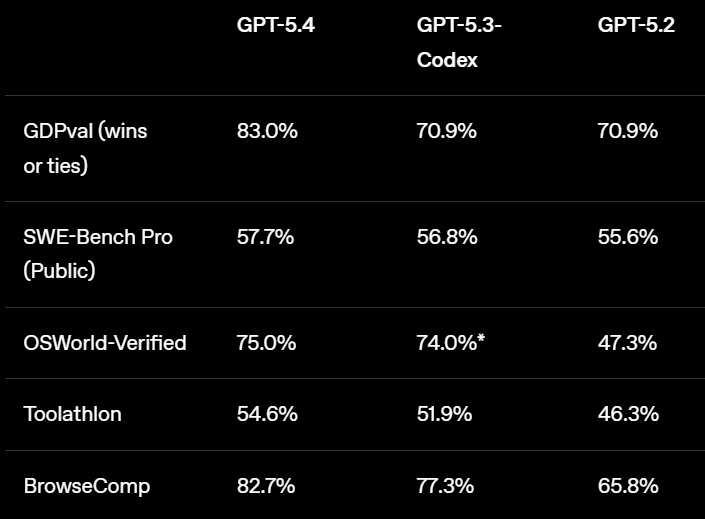
OpenAI has officially released GPT-5.4, describing it as their most capable and efficient model yet for professional work, marking a strategic shift by bifurcating their frontier technology into two specialized versions.
Details:
The "Thinking" variant is optimized for deep reasoning and complex problem-solving, capable of outlining its plan before generating a final answer and allowing users to adjust instructions in real-time
Designed for high-performance enterprise workloads, the "Pro" version features a massive 1 million token context window and is available for heavy environments to handle extensive documents and tasks
The system introduces native agentic capabilities that allow it to autonomously interact with computers, using vision to recognize interface elements and executing code to control mouse and keyboard
As agentic AI advances, the line between assistants and autonomous workers blurs. We’re excited to see what developers build with the 1M token window.
Turn AI Into Your Income Stream

The AI economy is booming, and smart entrepreneurs are already profiting. Subscribe to Mindstream and get instant access to 200+ proven strategies to monetize AI tools like ChatGPT, Midjourney, and more. From content creation to automation services, discover actionable ways to build your AI-powered income. No coding required, just practical strategies that work.
Anthropic
Why Anthropic Owns a Sustainable Advantage in Compute Costs

In frontier AI, compute isn’t just a resource—it’s the foundation of margin, throughput, and model iteration speed. While many labs rely on Nvidia, Anthropic has quietly built a strategic edge by diversifying its silicon infrastructure.
Details:
Anthropic runs a dual-hyperscaler, multi-accelerator stack using Google TPUs, AWS Trainium2, and Nvidia GPUs. This delivers 30–60% lower cost than Nvidia setups while improving supply resilience and negotiating leverage
OpenAI still depends heavily on Nvidia. Its custom chips with Broadcom likely won’t scale until 2027, and some major Nvidia deals have stalled, increasing exposure to pricing and supply risks
Microsoft’s Maia chip effort has faced execution challenges. As a result, it continues to rely on large Nvidia spending while its own chips remain mostly absent from production workloads
Ultimately, this divergence reveals that the winning economic model for frontier AI is not chip ownership but deep integration into hyperscaler silicon programs.
Top AI & SaaS Tools
CreativeOS (Life-time Deal): 10,000+ ready-made templates for ads, emails, and landing pages to launch campaigns quicker
TypeBoost: macOS AI writing toolkit that works in any app, letting you run custom actions on selected text without copying or switching tools [F-R-E-E]
Luma Uni-1: Plans and creates across text, images, video, and audio in one continuous conversation, with memory, self-review, and coordination of other models
Aident AI Beta 2: AI no-code automations across 1,000+ integrations and 23,000+ actions, triggered by real-world events and managed from one dashboard with chat updates [F-R-E-E]
Perplexity Computer Voice: Perplexity announced Voice Mode for Perplexity Computer, enabling users to interact by speaking and perform tasks using voice commands
“The Biggest Gold Mine in History”

11_Miso_Partnerships_1200x600.png
That’s what NVIDIA’s CEO said AI investors are tapping into. Market experts say it could send robotics stocks soaring on a "multi-year supertrend." But 39k+ investors skipped Wall Street, backing a private company NVIDIA chose to help make robots mainstream: Miso Robotics. Miso's restaurant-kitchen-AI robots logged 200k+ hours for brands like White Castle. With NVIDIA’s help and a new manufacturing partner, Miso’s scaling fast.
This is a paid advertisement for Miso Robotics’ Regulation A offering. Please read the offering circular at invest.misorobotics.com.
AI Tutorial
How to Turn a Product Photo Into a Cinematic Social Media Video

You do not need a full video shoot to create better product content. A single product photo, paired with the right prompt in Runway, can turn into a short video that looks far more dynamic than a static post.
Choose product image
Start with a clear product photo because Runway will use it as the starting frame for the video.
Prepare alternative
If you do not have a real product image, use a software mockup instead or generate a product image with Gemini for the brand first.
Upload photo into AI
Add the product photo into an AI tool and ask it to create a short video prompt for Runway based on that image.
Example prompt:
“Write a short cinematic video prompt for Runway based on this product photo. Make it suitable for social media, include natural camera movement, and suggest subtle product-focused animation.”Review generated prompt
Before using it, quickly check that the prompt matches the product and the style you want. Look for elements like camera movement that fit the product, with simple motion that feels natural.
Use Runway’s video tool
Go to Runway, launch the Video tool, and get ready to build the clip using your image and prompt.
Add starting frame and prompt
Inside Runway:
upload the product photo as the starting frame
paste in the AI-generated prompt
generate the video clip
Repeat process for more products
Once you get one good result, repeat the process for your other product photos. For social posts, try different combinations to see what works best.
You can test:
different text overlays
different versions of the same clip for different products
Note: Subtle camera movement often works better than dramatic movement, especially for product-focused content.
Top AI & Tech News
Meta is being sued over its AI smart glasses after Kenyan contract workers reviewed intimate user footage, including explicit content, without proper disclosure
Lightricks released LTX‑2.3, an updated open‑source video model, plus LTX Desktop, a no‑cost local video editor using the same engine
Cursor unveils always‑on automations that run on Slack, GitHub, PagerDuty, and webhooks to speed code review, incident response, and routine chores
AWS launched Amazon Connect Health, a HIPAA-eligible AI agent platform that automates healthcare admin tasks and integrates with EHR systems
AI Art Spotlight

With Nano Banana 2, you can use short sentences in your prompts to add the exact details you need to your outputs:
1. (top image) A full body portrait photo of a snow leopard

2. (bottom image) A full body portrait photo of a snow leopard. It has one paw raised as it is walking towards us. The snow on the ground is melting, and small purple and yellow flowers are showing with some grass. In the sky there is a sun dog. Behind, a sharp rock protrudes high into the sky. The warm light is catching the rock edge. The snow leopard's eyes are a radiant blue. Direct eye contact.
Model: Nano Banana 2
Prompt of the Day
The Prompt Engineer Masterclass

A hands-on prompt engineering mentor that guides learners through structured prompt design, from fundamentals to advanced system thinking, with a strong focus on clarity, intent alignment, modular prompts, testing across models, debugging, and continuous improvement through practice.
Featured AI Video
How to Unlock Hyperfocus (in the AI Age)
AI Course of the Day
Build and Train an LLM with JAX

A course on building a GPT‑2–style language model from scratch with JAX, taught by Google TPU engineer Chris Achard, covering the full pipeline from model design and data prep to training and chat-based inference.